
We first wrote about e-scooters back in 2021, in our blog:
‘Are e-scooters accidents waiting to happen or a public benefit?’
At the time, we said it was probably only a matter of when, not if, the legalisation of private e-scooters on public roads was likely.
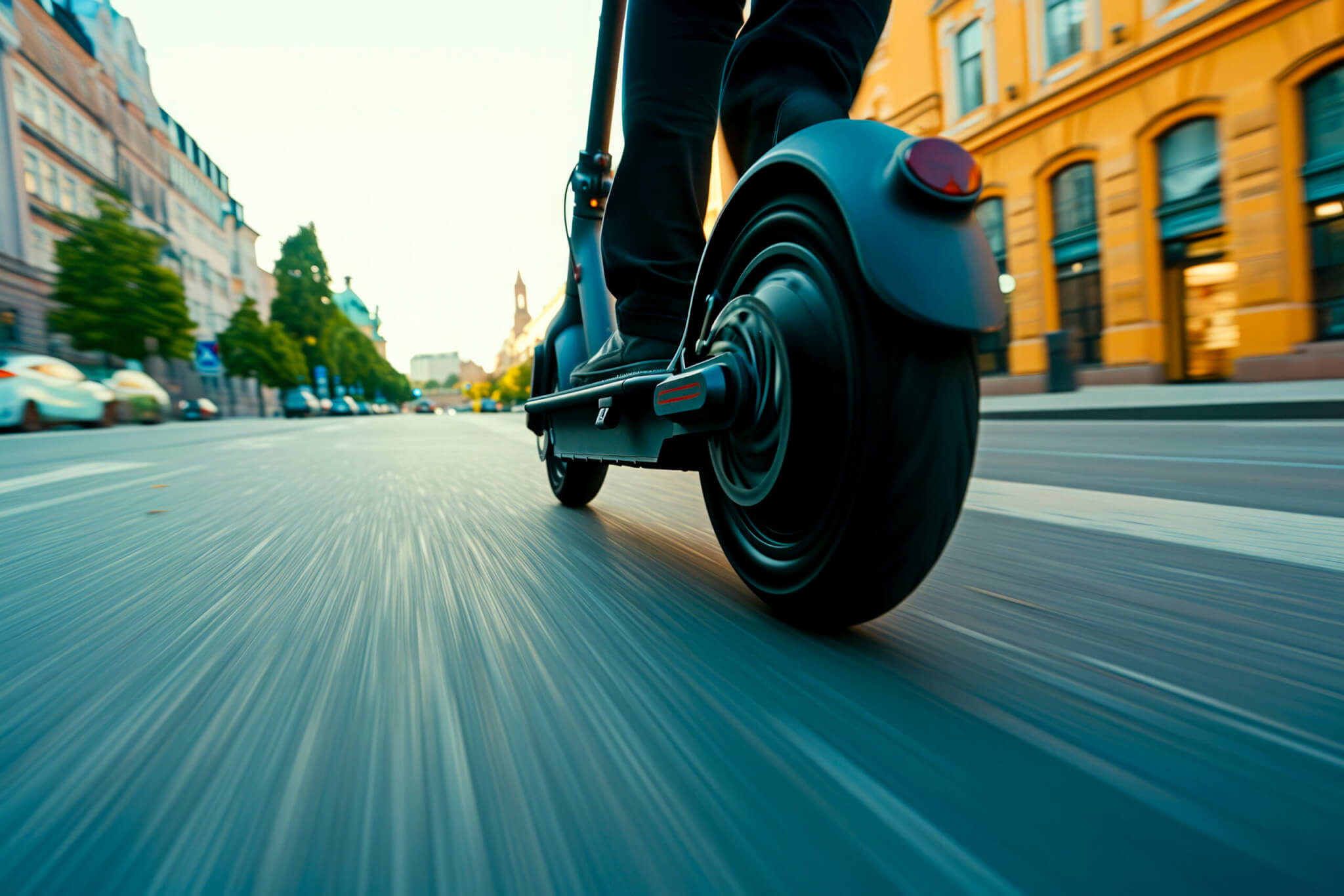
Five years on, it still hasn’t happened. Yet on any given day, you will see privately owned e-scooters weaving quickly through traffic or being ridden across pavements throughout England and Wales.
There are estimated to be around one million privately owned e-scooters in the UK, none of which can be ridden on a public road. Some riders appear unaware of this. A survey carried out by the Motor Insurers Bureau (MIB) found that 55 per cent of adults don’t know it’s illegal to ride a private e-scooter on the road.
So, where does the law stand in 2026, and what does it mean for anyone seriously injured by an e-scooter? Can I claim if I was hit by an e-scooter? Who pays compensation if an e-scooter rider has no insurance? Our article aims to answer these questions and more.
Are private e-scooters legal on public roads in 2026?
The legal position has barely moved since our last blog on the subject. While it is perfectly legal to buy a private e-scooter, it’s still illegal to ride one anywhere other than on private land, with the landowner’s permission.
That is because e-scooters are classed as motor vehicles under the Road Traffic Act 1988. Since they are treated as motor vehicles, private e-scooters cannot be legally ridden on public roads, pavements or cycle lanes. Riders caught doing so by the police face a fine, penalty points on their driving licence, and having their scooter seized.
To be used on a road, a motor vehicle needs insurance and must meet registration and construction requirements. Private electric scooters cannot meet those requirements, and no insurer will cover one for road use, so riding a private e-scooter on a public road is a criminal offence.
The only e-scooters that can legally be ridden on Britain’s roads are those hired through the government’s trial e-scooter rental schemes, which have been running since July 2020. Those trials have now been extended for a fifth time, until May 2028.
However, only English local authorities are taking part in these trials, at the time of writing. So, any e-scooters you see being ridden on public roads in Wales are being used unlawfully.
Is the law finally about to change?
Possibly. The government has repeatedly told Parliament that it is committed to legislating to regulate micromobility vehicles, including electric scooters, when parliamentary time allows. Ministers have confirmed that any new rules, which could include measures such as registration plates for private e-scooters, would be publicly consulted on before coming into force.
In November 2024, Jessica Morden, the MP for Newport East, introduced the E-scooters (Review and Awareness) Bill in Parliament. The Bill would require the government to review the current law and, tellingly, to promote public awareness of it. The fact that a Bill is needed just to make people aware of the rules says a great deal about the public confusion surrounding electric scooters.
For now, though, nothing has changed. Until new legislation is passed, private e-scooters must stay off public roads, and anyone riding one, other than on private land with the landowner’s permission, is committing a criminal offence.
How many people get injured in e-scooter accidents?
While the law has stood still, people have continued getting injured in e-scooter accidents.
The Department for Transport’s (DfT’s) provisional e-scooter accident figures for 2025 make sobering reading. Its best estimate is that 485 people were seriously injured and 989 were slightly injured in collisions involving e-scooters in Great Britain in the year, with 1,484 casualties in total. Ten people were killed, all of them e-scooter riders.
Pedestrians remain the group most at risk after riders themselves. The latest detailed figures, covering 2024, show that one pedestrian was killed, 59 were seriously injured and a further 158 slightly injured in collisions with e-scooters.
The Royal National Institute of Blind People has warned that electric scooters are extremely difficult for people with sight loss to see or hear, and its research found that 77 per cent of blind and partially sighted people say the behaviour of e-scooter riders makes them feel unsafe. For someone with sight loss, a near-silent machine travelling at 15 mph or more on a pavement is an accident waiting to happen.
Worse still, the DfT itself acknowledges that these figures almost certainly understate the true picture, because many e-scooter accidents are never reported to the police.
Why are e-scooter injuries often serious?
Pedestrians hit by an e-scooter have no protection whatsoever. Even a collision at 15 mph can cause them serious injury. Some privately owned e-scooters can reach much higher speeds because their speed restrictions may have been removed. The DfT’s own data shows that fractures and head injuries are among the most common serious injuries recorded in e-scooter collisions.
Older people and children are especially at risk, as are those less able to see or hear an e-scooter approaching. Electric scooters are almost silent, and much of the illegal riding takes place on pavements, precisely where pedestrians should be safest.
A fall onto concrete for an elderly person can mean a fractured hip and a long, uncertain recovery. A blow to the head can be worse still. As we explained in our blog ‘Why are brain injury claims so complex?‘, even a seemingly moderate head injury can have life-changing consequences, and the full effects may not become apparent for months.
When can you make a personal injury claim after an e-scooter accident?
As with any road traffic accident, you may be able to make a personal injury claim if an e-scooter accident was caused by someone else’s negligence.
A claim must normally be started within three years of the accident. This means court proceedings must be issued within three years of the accident.
Different rules apply where the injured person is a child or a person who lacks the mental capacity to manage their own claim.
Where the person at fault is the e-scooter rider, that negligence might take many forms, such as:
- A rider mounting the pavement and colliding with a pedestrian.
- A rider jumping a red light and hitting a cyclist or another road user.
- A rider weaving through slow-moving traffic and clipping a pedestrian stepping out at a crossing.
- A rider on the pavement swerving around one pedestrian and knocking over another.
In each case, the question is the same as for any road accident claim. Did the rider fail to take reasonable care, and did that failure cause your injuries? If so, you may have grounds to bring an e-scooter accident claim.
Who pays compensation if an e-scooter rider has no insurance?
If you are a pedestrian or cyclist who is injured by a rental trial e-scooter, the operator of the trial scheme is obliged to provide third-party insurance. If your claim is successful, compensation will be paid to you by the insurance company.
However, the situation is significantly more complex when the negligent rider was on a private e-scooter.
In these situations, the rider will not have valid insurance for use of the e-scooter on public roads.
Accordingly, the usual outcome in road traffic accident claims, in which the driver’s/rider’s insurer pays the compensation, is not going to happen if you are in collision with an illegally ridden e-scooter.
However, that should not put you off making a serious injury claim for injuries sustained in an e-scooter accident. Remember that electric scooters are classed as motor vehicles.
This means you may be able to seek compensation from the Motor Insurers’ Bureau (MIB), the body that compensates victims of uninsured and untraced drivers.
Claims involving the Motor Insurers Bureau can be complicated, so it’s sensible to get specialist legal advice at an early stage.
Can an e-scooter rider bring a claim if they were riding illegally?
If you were injured while riding an e-scooter because of another driver’s negligence, you may still have a claim, even if you were riding illegally at the time. Your own illegal use may affect matters, but it does not automatically prevent a civil claim being brought against a negligent driver.
You should obtain legal advice from a solicitor experienced in e-scooter accident claims rather than assuming the illegal use of your e-scooter automatically prevents you from bringing a claim. It isn’t necessarily the case.
Speak to our e-scooter accident solicitors at Mooneerams
Mooneerams are experienced, award-winning personal injury solicitors based in Cardiff. We deal only with claimant personal injury cases.
If you or a loved one has suffered a serious injury in an accident involving an e-scooter that wasn’t your fault, please call us on 029 2048 3615 or use the contact form on this page, and we will get back to you shortly.

Posted in Road Traffic Accidents