
Yes, in most cases you can. A claim for an injury caused by a falling object at work does not depend on knowing who let it fall. You bring it against your employer, or whichever company controlled the work or the site, and it turns on whether the racking, scaffold, or system of work was reasonably safe. An accident report might not identify the individual whose actions caused an object to fall, and in many cases, it does not need to.
The more important question is often why the object fell in the first place. For example, were there failures in storage, inspection, maintenance or supervision?
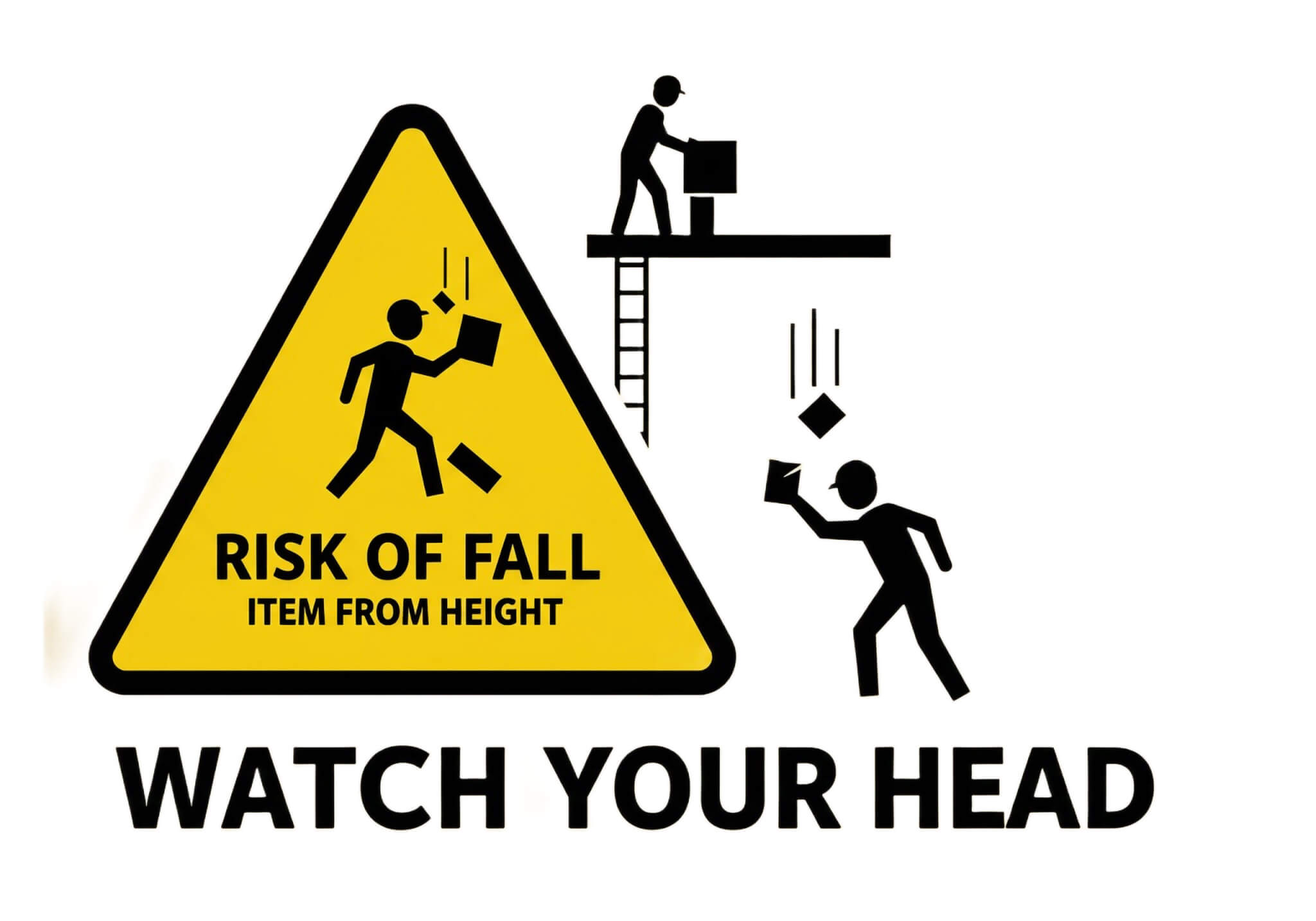
Being struck by a moving or falling object killed 21 workers in Great Britain in the year to March 2026; only falls from height and moving vehicles killed more. Fortunately, deaths are rare. Most falling-object injuries are fractures, head, neck, and shoulder injuries, and crush injuries to hands and feet.
Why do you not need to know who dropped the item that fell?
There are three reasons the person’s identity rarely matters.
Your employer is responsible for what their workforce do whilst carrying out their normal work duties
Employers are usually held responsible for what employees do while working. In law, this is called ‘vicarious liability’. If a colleague stacked the load carelessly, your employer answers for that, even if nobody can say which colleague it was. We explain this in more detail in our FAQs under Can I claim if I was injured by a colleague’s mistake?
The questions are about the racking, the scaffold, or the load, not the person
Who did what is usually beside the point. When a carton comes off the top of pallet racking, investigators want to know whether the beams were damaged, whether the load exceeded the weight on the notice, and when the racking was last inspected. When a tool drops from a scaffold, they ask about toe-boards, netting, tool lanyards, and whether there was an exclusion area at ground level. When a load falls off a forklift, they ask about training, how the load was secured and whether pedestrians were kept out of vehicle routes.
Questions about how the work was organised are often more important than identifying who actually dropped the object.

Sometimes the accident itself can be evidence of negligence
The ‘nobody knows why it fell’ situation is not new. As far back as 1865, in a case called Scott v London and St Katherine Docks, six bags of sugar dropped from a dock warehouse onto a customs officer walking below, and nobody could say how.
The court decided that when something under a company’s control falls and injures someone, and it’s the type of thing that does not happen when proper care is taken, the fall itself is evidence of carelessness unless the company can show otherwise. Lawyers call this ‘res ipsa loquitur’, which means ‘the matter speaks for itself’.
The mere fact that an object fell may itself provide evidence of negligence, even where nobody can explain precisely how it happened. The employer can then produce evidence explaining what happened and the precautions that had been taken, which the court will consider alongside all the other evidence.”
Even if you know who dropped the object, that may not settle the question of liability. If it was a work colleague, your employer may still be responsible for their negligence. If it was someone working for another contractor, responsibility may lie with that contractor, the principal contractor, your employer or more than one party, depending on how the accident happened.
If I’ve been hit by something falling from height, who do I claim against?
Usually your employer. Almost every employer must hold at least £5 million of employers’ liability insurance, so in practice a successful claim will usually be dealt with and paid by the employer’s insurer, rather than by the individual who dropped the object or the employer.
Where a company has since closed down, the Employers’ Liability Tracing Office can often identify the insurer that provided cover at the time.
What if the object belonged to another company?
You can still claim if the object was not your employer’s. The only difference may be who you claim against. Here are some common examples:
- A subcontractor’s gang working above you on site. Responsibility may lie with the subcontractor and potentially with the principal contractor too. Under the Construction (Design and Management) Regulations 2015, the principal contractor is responsible for managing the risks of tradespeople working above and around each other. Our building site injury claims page has more on this.
- A supplier’s pallet that collapsed in your yard. Your employer may be liable for how it was received and stored, and the supplier may be liable if the pallet was faulty.
- A business client’s warehouse where you were placed by an agency. The business where you are working will normally have day-to-day responsibility for health and safety, but the agency or employment business may have responsibilities too. Who you should bring a claim against depends on the circumstances.
We have separately answered the question Can agency or temporary workers claim?
- Premises you were visiting for work. Your claim would usually be against the occupier, which owes a duty to everyone lawfully on the premises, although your employer or another contractor may also be liable. This depends on how the accident happened.
If you are self-employed, that does not by itself rule out the possibility of bringing a claim. Businesses and other persons who control the premises, work equipment or the way the work is carried out, may still owe you a duty of care.
Working out which company or companies to pursue is part of our job and naming more than one is not unusual. You do not need to resolve any of this before you ask for advice. Let us know what you know and we will work the rest out!
What if I stacked it myself?
Some people hold back from claiming because they suspect the person who put the load there was actually them, on an earlier shift! That does not bar a claim.
How a load ends up stacked is part of a larger picture. The training and instructions you were given, the safe working load notice on the racking, whether damaged beams had been taken out of use, and whether anyone checked the bay, all play a part in deciding who was to blame.
If you stacked a pallet the way you had been trained to, on racking that had not been inspected, the failure may still be your employer’s, not yours. If the matter goes to court, your compensation might be reduced to reflect your own share of the blame for the accident.
What should do in the first two weeks following an accident?
Your employer’s own records, such as risk assessments, racking inspection reports, training records and method statements, are evidence we can obtain later.
Only you can capture what’s available now and might not be later. If you can, we recommend you do as much of the following as possible:
- Photograph the scene, including the racking, the scaffold, the pallet or the vehicle, before it is repaired, unloaded, or cleared.
- Photograph the object that hit you with something in the frame to show its size.
- Write down who was nearby, including agency staff and delivery drivers.
- Note the time as precisely as you can. CCTV is searched by time.
- Keep a note of any treatment you had, including a GP or A&E visit. We can obtain your medical records, but your own notes will jog your memory later.
- Ask for the CCTV in writing. Data protection law gives you the right to a copy of footage in which you appear, and your employer will usually have a month to respond.
Many workplace systems overwrite footage within a few weeks, so the request needs to go in early. A short email is enough, giving the date, the time, and the camera or area, and asking that the footage be preserved and a copy supplied to you.
- Ask to see the accident book. Employers with more than ten employees must keep one. If the entry recorded by your employer does not reflect what happened, make sure your own version of the event gets recorded too.
If your accident was not recorded at all, write your own account straight away. Date it and keep a copy. HSE estimates that only around half of RIDDOR reportable non-fatal injuries to employees are actually reported, so an unrecorded accident is not uncommon. The fact it has not been recorded does not stop a claim.
What does the health and safety investigation look at?
Since October 2013, your employer breaking a safety regulation is not enough on its to win a claim. You have to show that it failed to take reasonable care. In practice, the regulations can still be important evidence of what reasonable care requires, and an employer that ignored these things will struggle to argue it was being careful.
Where people are working at height, regulation 10 of the Work at Height Regulations 2005 requires employers to take suitable steps to stop objects falling and, where that is not possible, to prevent anyone from being struck. Materials have to be stored so they cannot collapse, overturn, or move on their own.
Away from height, every employer must assess the risks and provide a safe system of work. Racking, shelving, forklifts, and lorry-mounted cranes are all work equipment that must be suitable, maintained, and inspected.

For racking, the HSE’s warehousing guidance, HSG76, expects load notices fixed to the racking, a regular inspection routine with damaged uprights and beams taken out of use, and a named person responsible for racking safety. The guidance is not law in itself, but it is the benchmark inspectors and courts use, and an employer that has not followed it needs a good reason why. Our warehouse accident claims page has more on racking failures.
A recent prosecution shows how this works in practice. In January 2026, Blyth Marble Ltd was fined £50,000 at Hamilton Sheriff Court after a worker at its yard in Larkhall, Scotland, was killed by two granite slabs weighing over 900 kilograms. They fell from a lorry loader after workers removed the vertical posts that would have held them upright. HSE’s investigation identified shortcomings in the company’s safe system of work, including the lack of a requirement to keep the posts in place and inadequate instructions for lifting more than one slab.
While this was a criminal prosecution rather than a compensation claim, it illustrates why an investigation often looks beyond the immediate act that caused an object to fall and examines how the work was planned, supervised and carried out.
How much compensation could I get?
Compensation comes in two parts. The first is for the injury itself, assessed using the Judicial College Guidelines, the book judges and personal injury solicitors use to put a figure on each type of injury. Fractures, head injuries, and shoulder injuries, the most likely types of injuries when a falling object, hits you, each have their own bracket of compensation, and where you fall within it depends on how bad the injury is and how long your recovery is likely to take. Our compensation calculator gives a rough idea, but a conversation with someone on Mooneerams team, will give a better one.
The second part is for what the injury has cost you financially. Those losses might include:
- lost earnings, including overtime and future losses if you can’t return to the same work
- treatment and physiotherapy
- care costs
- travel, and
- equipment or adaptations if the injury is serious.
Where you have had to take time off work, this second part is often the larger of the two. Our falling object compensation claims page has more on what you can recovered.
How long do I have to claim?
Under the Limitation Act 1980, a personal injury claim in England and Wales must be issued at court within three years of the accident. If you did not know until later that your injury was significant and connected to it the negligence that led to the accident, the three years run from that later ‘date of knowledge’. For anyone under 18 at the time of the accident, the three years start on their eighteenth birthday. There is more in our guide to how long you have to claim for an accident at work.
Can I carry on working for my employer if I claim?
Yes. Many people hold back from claiming because they are worried about their job. In reality, most people carry on working for the same employer throughout, and the compensation is paid by your employer’s insurer, not by your employer personally.
Dismissing someone because they raised a safety concern is automatically unfair, whatever their length of service. Dismissing someone for bringing a claim is also unfair. We have written more about what happens if you are injured at work and then dismissed.
How Mooneerams can help
We act only for injured people, never for insurers, and we run accident at work claims throughout England and Wales from our offices in Cardiff. On the first call we will tell you whether we think you have a claim. That call is without any obligation to go; you decide what happens next. If you decide to go ahead with a claim through us, we usually handle claims on a No Win, No Fee basis. We’ll explain exactly what that means before you sign anything.
Call us on 029 2199 1927 or leave your details and we will call you back.

Posted in Accidents at Work, Personal Injury Claims